Overview
Perimenopause can estrange a woman from her own body. This phase of life goes untaught and medically under-supported, so women navigate it largely on their own. Touchstone offers recognition and support in the moment, bringing her back towards herself.
1The object and the interaction
An intelligent necklace to stay in touch with yourself
Because it’s a wearable, Touchstone is with her right in the moment she needs support.
She squeezes the necklace and tells Touchstone what’s going on, in her own words, then squeezes again when she’s done (so she doesn’t get cut off mid-sentence like Siri or Alexa might do). Touchstone reflects back what she shared and offers her a choice:
- a guided somatic exercise to shift how she feels right now
- a strategy or reframe that another woman found helpful in a similar situation
- or simply logging it
Light and haptic feedback support every step. She can talk to the necklace directly, or pair Bluetooth earbuds when she wants more privacy.
Three kinds of somatic exercise
2Where I started: embodiment
Why focus on perimenopause (at my age)?
I started from a broad question: how might technology help us connect more deeply with our inner sensations, instead of pulling our attention away from our bodies? (Can you relate to sitting at your laptop for hours, forgetting to drink water or go to the bathroom or shift your posture?)
To narrow it down for a 9-week project, I chose a group whose bodies are changing underneath them, where staying attuned to those changes really matters: women in perimenopause.
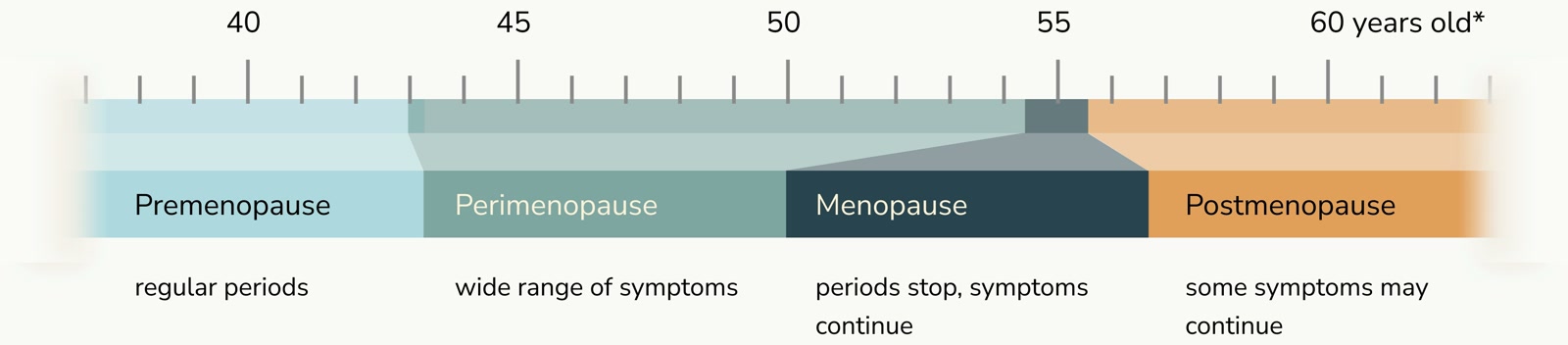
Perimenopause is the phase leading up to a woman’s last period. It affects over 650 million women worldwide, 85% of whom have symptoms, often for a decade or more. Symptoms range from subtle to life-ruining, and every woman’s experience is different.
3What I learned from women
What I learned about perimenopause
I interviewed 7 women across the pre-, peri- and post-menopausal spectrum, plus 2 menopause experts.
Self-blame comes before blaming hormones.
Brain fog, insomnia and mood swings are hard to pin on hormones, and women juggling careers, kids and aging parents always have another explanation to reach for. Many land on blaming themselves.
Recognition comes from other women.
94% of women were never taught about menopause in school, and over two-thirds of OB-GYN programs have no menopause curriculum. So a woman often doesn’t recognize her experience until she sees it mirrored in someone else’s story, and if she’s the first in her friend group, she’s going in blind.
Suffering quietly is the default.
As the co-founder of a menopause clinic put it, women are conditioned to suffer and power through.
“The thoughts easiest for me to access were: maybe you’ve reached the level that your smarts will carry you to. Maybe you’re just not as good. Maybe you’re just not as smart.”
— Participant, on her experience of brain fog
On the default path, she blames life or herself, adjusts something, doesn’t get relief, and keeps looking, sometimes for years. On the other, she recognizes the change as hormonal. She may still have to fight for support (its own can of worms), but at least she’s troubleshooting the right problem.
What separates the two paths is almost always recognizing her experience in another woman’s story. So the question I took forward was: how do you make that recognition path more likely, and how do you get it to her sooner?
4What I learned from somatic practitioners
What I learned about designing for embodiment
To understand how to design something that brings people back into their bodies, I talked with 5 somatic practitioners: a yoga teacher, a body worker, a dance teacher, a contact improv facilitator and a somatic therapist. From those conversations I distilled a set of somatic design principles, and each one shaped a decision about the object.
- 1Design for return. Presence is habitually trained.A necklace, worn daily, that becomes a talisman for checking in
- 2Access the body through the senses, not the mind.Tactility, weight and a squeeze gesture (NOT an app!)
- 3Alongside, not alone. Feeling accompanied but not watched makes it easier to drop into your own experience.Connected to other women’s strategies
- 4Language is empowering.The AI lifts out the useful strategies, and the somatic exercises work with how she actually feels instead of how she “should” feel
- 5Start simple, build slowly.Voice first, then a gestural shorthand as she gets familiar
5How I got there: prototypes
Prototype, prototype, prototype
Prototypes answer questions. I had two big ones.
Does hearing another woman’s story actually help?
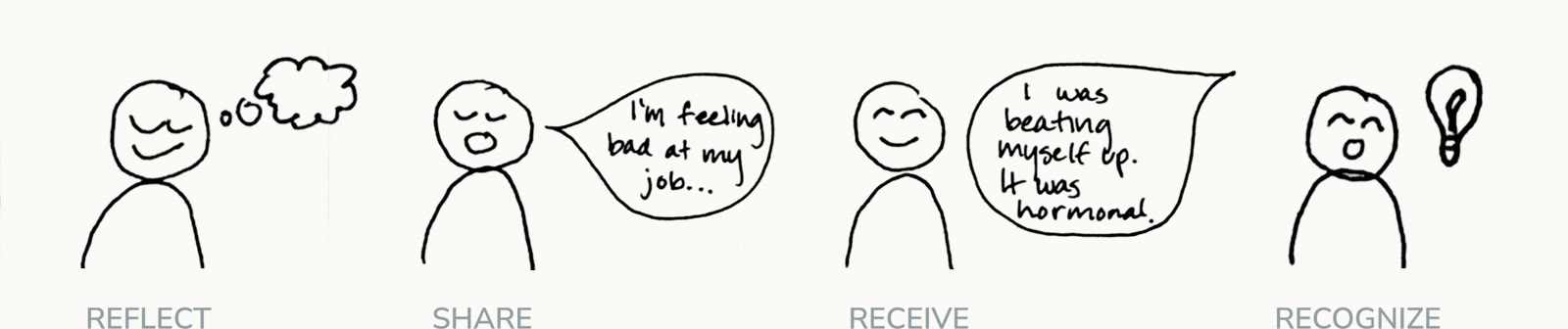
My initial concept was borrowed hindsight: an object that lets a woman share what she’s feeling and hear a relevant story from another woman, in that woman’s own words, to spark the recognition that fuzzy symptoms (like brain fog, energy shifts or mood swings) are hormonal.
I built a working prototype using real stories from my interviews and tested it with two women. I also collected 10 more perimenopause stories through a Google form.
The learning: it felt interesting but not useful. These women are exceptionally busy and need something they can act on, and raw stories were often pretty bleak, which isn’t what you want at 3am.
This led me to realize it’s not the stories, it’s the hard-won knowledge inside them. So Touchstone shifted to strategies and reframes that helped other women, plus somatic support for the moment itself. The women are still the source; an AI voice just pulls out the useful part and gets it to her in a form she can use.
What form should this object take?
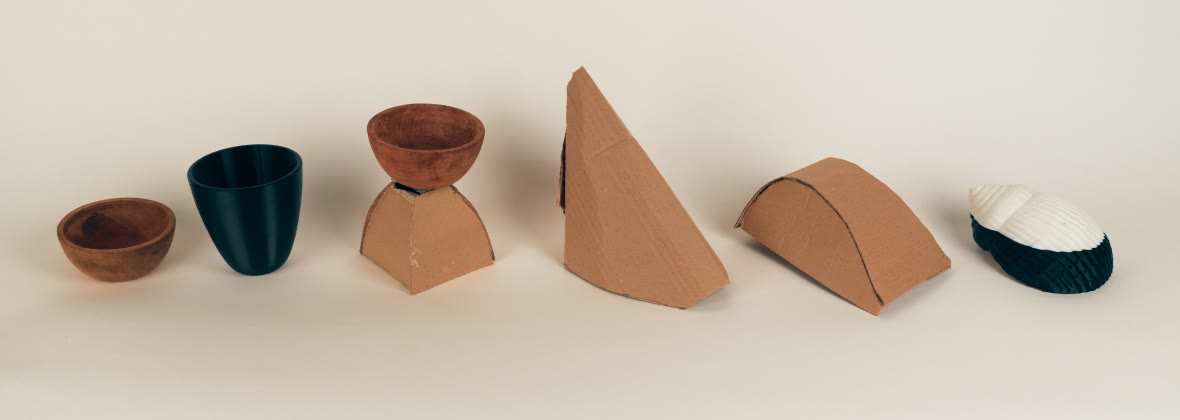
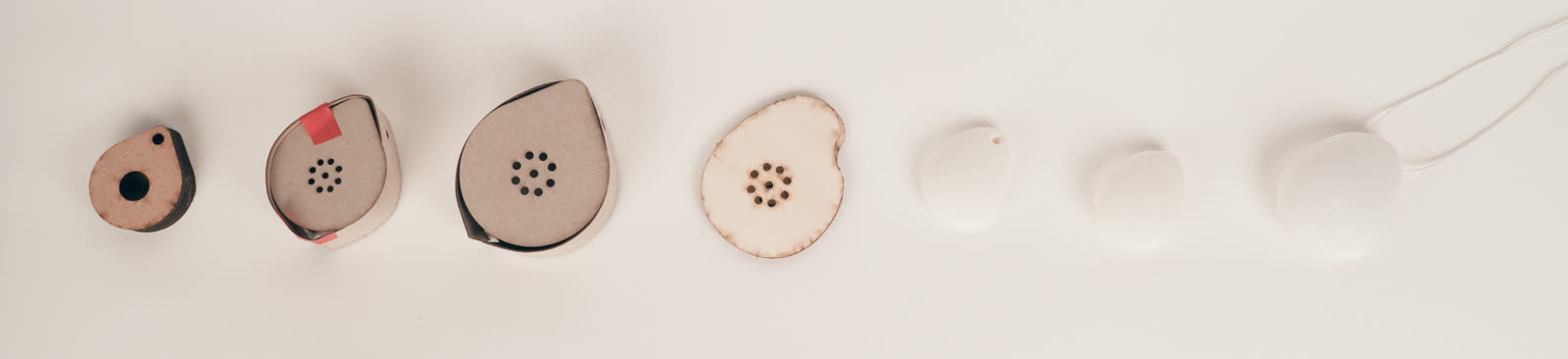
I started with a personal object: some sort of ritual home object that could live in a woman’s home and also be a beautiful piece of art. My first prototype showed that having a personal object to confide in was valuable.
“You get tired of moaning about the same things to the same people. You exhaust their ears.”
— Participant
But if support has to arrive in the moment, it has to be with her all the time. One participant described waking at 3am, not wanting to wake her partner, and not wanting to be on her phone.
So why not an app? Picking up your phone pulls your attention outward (work, messages, the news), and I was designing for the opposite.
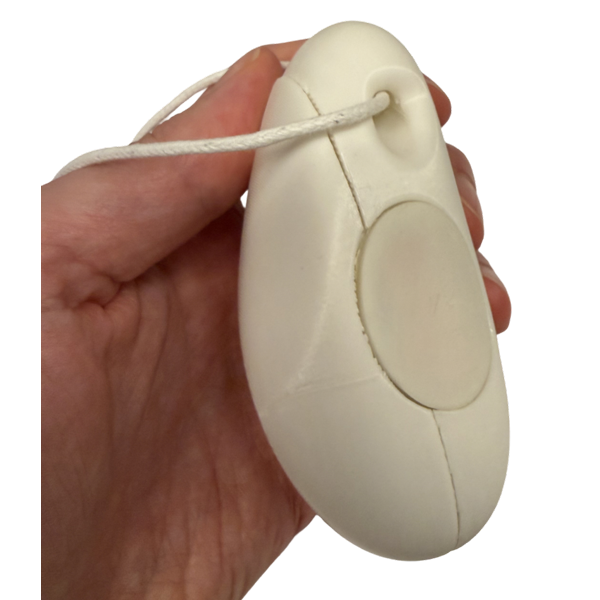
I chose to create a necklace, both because it can be with her in the moment she needs it, and because bringing your hand to your torso stimulates the vagus nerve, which calms the nervous system. I tested wearable forms with several more people, and the organic shape went over really well:
“It’s almost like you’re carrying an outer part of your inner body.”
— Participant
6How it works
How it works
Honing the squeeze
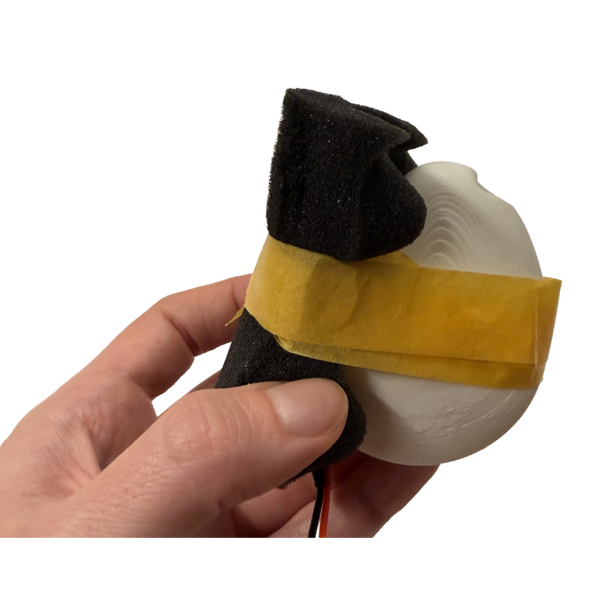
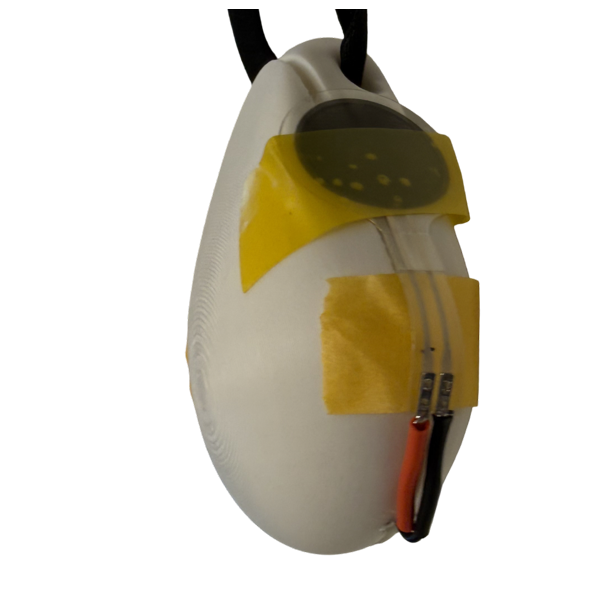
Touch triggered too easily, so I went with a squeeze, which felt intentional and grounding. Foam had no resistance. A pressure sensor on hard PLA had no give, so it didn’t feel like you were doing anything. So I 3D printed the button in flexible TPE at different thicknesses until one finally had some give.
Light, buzz and sound
I’d originally planned for the buzz to come after the squeeze, as a kind of “got it.” But that felt clunky, and it wasn’t clear the squeeze had registered, so I made the buzz happen with the press.
The light is purple when Touchstone speaks and white while it listens. While it thinks, it pulses purple with a calming ocean sound (close to white noise, and definitely not elevator hold music).
Under the hood
- In the necklace: the TPE squeeze button, NeoPixel lights and a vibration motor (Arduino Modulino Vibro), run by an Arduino Nano, powered by a battery
- On the laptop: the app, which sends speech to text, uses Gemini to understand what she shared, pulls a strategy or reframe from a repository by tags, has Gemini write the response, and speaks it with Google text-to-speech
- Audio: through Bluetooth earbuds
The responses in the demo were live, not scripted. Two things were simplified: the repository was fixed, so it didn’t grow as people shared, and there’s no mic or speaker in the necklace itself, because small off-the-shelf audio parts sounded bad.
An interaction that evolves over time
On day 1 with Touchstone, it’s mostly a conversation. But talking to an AI every time gets tiring, so as she gets to know it, she can skip ahead with gestures.
- Single squeezeLogs whatever she’s shared
- Double squeezeAnother woman’s strategy
- Long squeezeSomatic guidance
A growing reservoir of shared knowledge
Every exchange would feed a living reservoir of strategies, and a companion app would show her patterns over time. Neither was built for this prototype; the squeeze, voice, light, haptics and somatic exercises all worked.
7What’s next and what I learned
What I’d do next
A longer study. Testers struggled at first with squeezing to finish talking, so I’d love to give women a Touchstone for longer and see whether the gestures start to feel intuitive.
Beyond the device. Could Touchstone connect women going through this in real life, or be passed down to a daughter or niece? My whole project rests on the beautiful fact that women help each other through this. I want Touchstone to build on that, not stand in for it.
Partners. What if biometrics from other wearables could augment what she shares with Touchstone? Or partner with a women’s healthcare platform to include doctor-approved strategies?
What I learned
Letting go, over and over. I’m excited to have landed on something this somatically driven. That’s what I wanted from the outset, but I pictured “embodied interface” as something very different. I had to let go of the idea in my head again and again and let the process lead.